
By Dr. Andrew Fogel, Visiting Scholar (2025-2026)
Behind the Cowl: Batman and Bob Kane
In 1939, Batman debuted in Detective Comics issue twenty-seven with a May cover date. The comic book hit newsstands, according to copyright records, on March 30. Eighty-seven years later, copies of this rare piece of Americana sell for nearly two million dollars. Batman helped build the comic book industry and laid the groundwork for the modern superhero phenomenon. Generations of fans have been thrilled by his adventures in comic books, animated cartoons, television, and movies. But what lies behind the cowl of the character and his creators?
The historical reality of Batman’s composition and the Jewish men who shaped him is inseparable from the white Anglo-Saxon Protestant (WASP) ideal. Batman’s writer, Bill Finger, enacted this Anglo-Saxon identity narratively. Meanwhile, his artist, Bob Kane, publicly embraced it in his own life, even as he remained connected to his Jewish heritage.
To address the issue of twin masks, I analyzed documentary sources, explored archival materials, and interviewed the grandson of Batman’s illustrator. The story of the Caped Crusader and his makers illustrates the social, racial, and economic pressures of twentieth-century American life and the expectations of assimilation into the cultural mainstream.
Kane capitalized on the success of Superman, who debuted the previous year. Editor Vin Sullivan wanted a new superhero for their flagship magazine and told Kane that Superman’s creators were each making $800 a week—roughly $19,000 today. “To make that kind of money, I’ll have one for you on Monday!” Kane recalls replying to Sullivan in his 1989 autobiography Batman & Me.1
With substantial help from Finger, he dreamed up a macabre superhero that drew from contemporary culture. Batman embraced the archetypes of the extraordinary sleuth and two-fisted crusader in pulp magazines, comic strips, movies, and popular literature. Like Superman and his literary progenitors, Bruce Wayne and his alter ego Batman expressed the American fantasy of the Anglo-Saxon pioneer. The name combined those of Scottish King Robert the Bruce and American Founding Father “Mad” Anthony Wayne. Finger later explained that he constructed his crime fighter to be “a man of gentry” and “searched for a name that would suggest colonialism.”2
Batman’s artist lived in the Bronx with his parents and younger sister and aspired to change his economic status. Like other Jewish entertainers in cinema and comics, he Anglicized his surname to avoid antisemitism and xenophobic prejudices. By transforming his identity on the public stage from Kahn to Kane, he yielded to the myth that America is a WASP nation.3
Kane, who grew up poor, desired to become his rich, aristocratic, and debonair creation. He likened himself to Wayne and the Dark Knight. “I really am Batman. When I was younger, I looked just like Bruce Wayne. I got the image from myself. Bruce Wayne—Bob Kane,” he wrote in his 1989 People magazine article to promote his memoir and the release of the major motion picture starring Michael Keaton and Jack Nicholson. Kane replicated this language in Batman & Me. “Bob Kane, Bruce Wayne, Batman — they are one and the same,” are the words etched into his gravestone. While not a genteel WASP, he played one to the crowd.4
“He made himself up in the same way that Bruce Wayne makes up this Batman. He was born Bob Kahn, went for the Bob Kane name very early,” Gerard Jones concurred in the documentary Secret Origin: The Story of DC Comics. “He was very dapper, very concerned with his appearance. He really wanted to be, I think, a movie star. And he also wanted to be a successful, non-ethnic New York socialite.” Kane, according to Jones, dressed the part once he moved to Los Angeles.5
“He was in full-on peacock mode displaying himself as Batman’s real-life alter ego,” author Marc Tyler Nobleman declared about Kane’s self-presentation after the success of the beloved campy 1960’s Batman television show.6
Kane’s well-crafted persona emerges in his autobiography. He reports celebrating Christmas rather than Chanukah with his family and compares his father to Santa Claus. Simultaneously, Kane mentions his mother’s “chicken soup with matzo balls” but does not state that he is Jewish in the text.7
His emphasis on Christmas suggests an awareness of the nation’s Christian audience and conveys the struggle religious outsiders experience in America. Christmas is, as Andrew R. Heinze describes, “the American rite of consumption.” Observance, regardless of one’s faith, could thwart allegations of foreignness or “a lack of integration into American culture,” insists fellow historian Penne L. Restad.8
Fashioning himself as the ideal American, which many in his generation felt was a necessity for economic survival and upward mobility, did not mean that Kane abandoned his Jewish identity. He proudly wore a mezuzah necklace and attended synagogue on the High Holidays. He loved eating at the deli and had a particular appetite for matzo ball soup, just as his memoir hints. These details that Kane’s grandson shared with me paint a picture of the man, not the public figure.
Kane also moved in Jewish circles and made his way to the Borscht Belt in the summer. He vacationed at Grossinger’s Country Club in the Catskill Mountains on more than one occasion. Kane recalls meeting artist Jerry Robinson, who has been credited with creating Batman’s sidekick Robin, there in 1939. (Robinson, however, contended that they met at a resort in the Poconos on Labor Day weekend.)9 Later in his career, Grossinger’s listed Kane as a featured guest in an August 11, 1957 advertisement for The New York Times.
These references inspired me to explore the Grossinger’s archival materials, mostly photographs, held by YIVO Archives at the Center for Jewish History. I went through the handwritten card catalog in hopes of finding a record of Kane’s 1957 appearance. Two nondescript entries, one numerical and the other alphabetical, cross-referenced an image of “Bob Kane, cartoonist.” With photograph number 140, I then searched for the corresponding box. To my surprise, the sepia picture displayed a date in the lower right-hand corner of 1946.
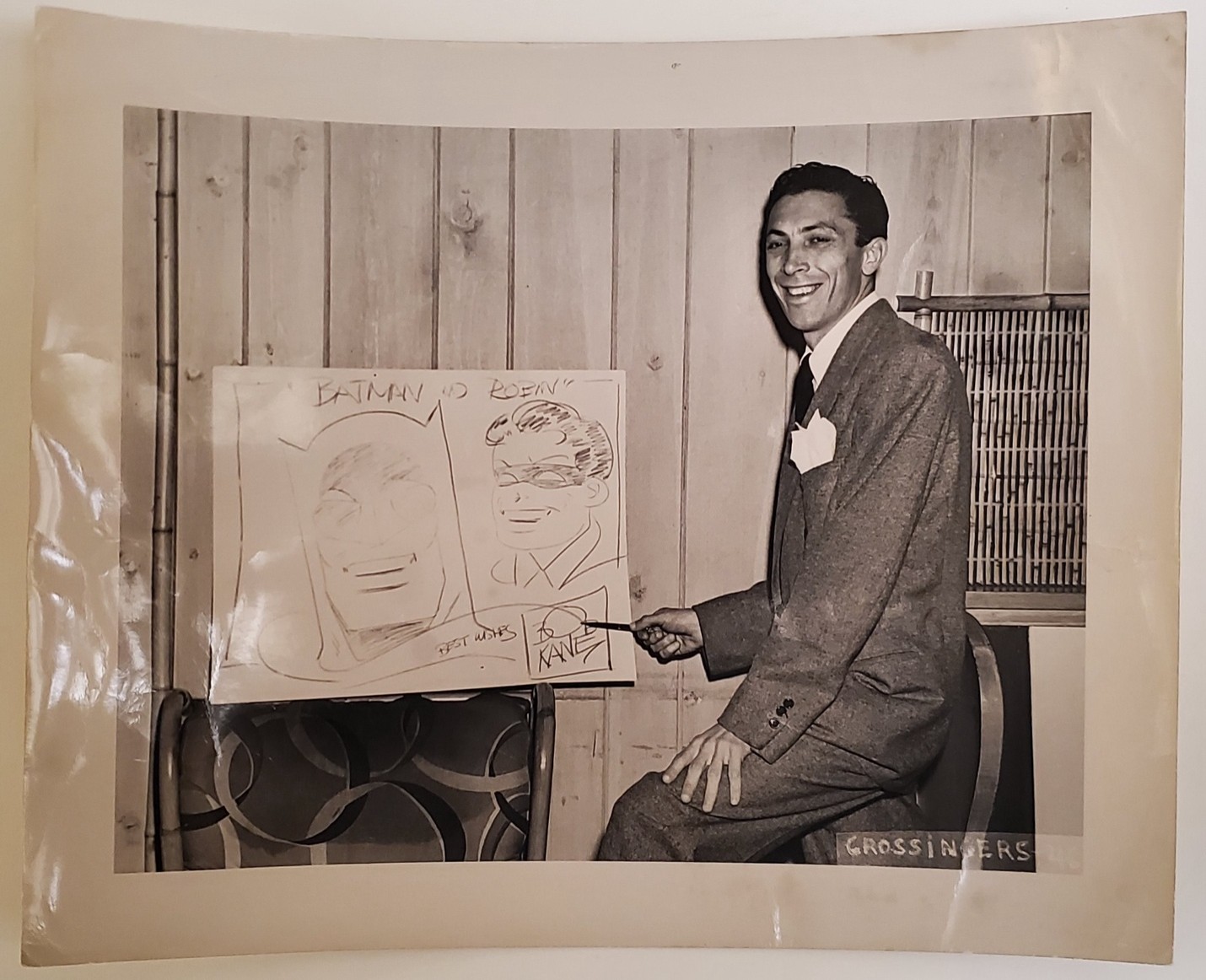
Grossinger’s Country Club Collection. RG 1195. Photo no. 140. Collection of YIVO Archives.
Kane, wearing an ill-fitted suit, faced the camera and smiled. He sat confidently next to a drawing he made of the heads of the Dark Knight and Boy Wonder. Holding a pen with his right hand, he pointed to his iconic signature with an enlarged letter “O” enclosed inside a box in the lower right-hand corner. Kane titled his drawing “Batman and Robin.” It is a familiar sight. He often sketched them for both kids and adults, delighting fans by illustrating the procedure for drawing the Dynamic Duo.
Fans, enthusiasts, and scholars tend to emphasize the hidden Jewishness of superheroes even though they are constructed in the Anglo image. Rather than focus on trying to find a Jewish subtext in their art, it is more fruitful to explore the Jewish lives of the creators often hidden in archives. The professional demands of a national audience required Kane to hew to the Anglo-Saxon standard, but he did not forsake his heritage in his personal life, as attested by his grandson and the photo. Kane lived his own dual identity, just like his superhero.
Related Materials at CJH
Collection: RG 1195, Grossingers Country Club
Books: Adapting to Abundance: Jewish Immigrants, Mass Consumption, and the Search for American Identity / Andrew R. Heinze.
A Rosenberg by Any Other Name: A History of Jewish Name Changing in America / Kirsten Fermaglich. New York University Press, 2018.
Subject Guide: Comics and Graphic Novels
Exhibition: The Jack Kirby Way: How a Boy From the Lower East Side Became the King of Comics
Notes
- Bob Kane, Batman & Me, with Tom Andrae (Eclipse Books, 1989), 35
- Bob Kane, Batman & Me, 41, 43–44; Marc Tyler Nobleman, Bill the Boy Wonder: The Secret Co-Creator of Batman (Charlesbridge, 2012); Andrew Fogel, “Is Superman Jewish?,” Pop Matters, June 11, 2025, https://www.popmatters.com/superman-jewish-or-wasp; Jim Steranko, The Steranko History of Comics, vol. 1 (Supergraphics, 1970), 45.
- 1930 US Census, Bronx, New York, Enumeration District 3-346, Supervisor District 25, 26B; 1940 US Census, Bronx, New York, Enumeration District 3-1411, Supervisor District 23, 61A; Kane, Batman & Me, vii, 3, 11, 30, 152; Gerard Jones, Men of Tomorrow: Geeks, Gangsters, and the Birth of the Comic Book (Basic Books, 2005), 135. Kane’s addresses, according to the 1930 and 1940 Census, were 1034 Freeman Street, Apt. 548, Bronx, NY, 10459 and 2255 Concourse, Apt. 432, Bronx, NY, 10453)
- Bob Kane, “My Son, The Batman: A Proud Memoir By The Artist Who Sired Gotham’s Defender,” People, July 31, 1989, 36; Kane, Batman & Me, vii, 3, 6, 11, 143, 152 and iv, 44, 152. See also “Caped Creator: Cartoonist Bob Kane leaves the world a rich gothic legacy: Batman,” People, November 23, 1998, 66.
- Jones, Men of Tomorrow, 305.
- Batman & Bill, directed by Don Argott and Sheena M. Joyce, released May 5, 2017, on Hulu.
- Kane, Batman & Me, 5–6, 120.
- Andrew R. Heinze, Adapting to Abundance: Jewish Immigrants, Mass Consumption, and the Search for American Identity (Columbia University Press, 1990), 71, 73–78; Penne L. Restad, Christmas in America: A History (Oxford University Press, 1995), 115–16, 157–59.
- Kane, Batman & Me, 101; Gary Groth, “Look Out, Batman! It’s The Jerry Robinson Interview!,” The Comics Journal, no. 271, October 2005, 77, 79; N. C. Christopher Couch, Jerry Robinson: Ambassador of Comics (Abrams ComicArts, 2010), 27–28.



Real problem with the article. Bill Finger was Jewish. The article clearly states otherwise I really do think this article needs to be reviewed with that in mind, considering that Finger was not given proper credit for his co-creation by Kane.
We appreciate your feedback, Ryan, thank you for sharing! Finger is identified as Jewish and a co-creator in the second paragraph, however your comment will be passed along to editors to consider for further edit and clarification. If you have additional suggestions, please email inquiries@cjh.org