
By Martin Saps, Center for Jewish History-Fordham University Short-Term Research Fellow (2026)
Williamsburg: A New Piece of the Old Country
When it first opened in 1903, the Williamsburg Bridge was nicknamed the “Jews’ highway” for the sheer amount of Jewish New Yorkers leaving the crowded tenements of the Lower East Side for a better life across the water. By the 1960s, however, the children and grandchildren of those who traversed the bridge were undertaking a new project: suburbanization brought upon through assimilation into the white middle class.
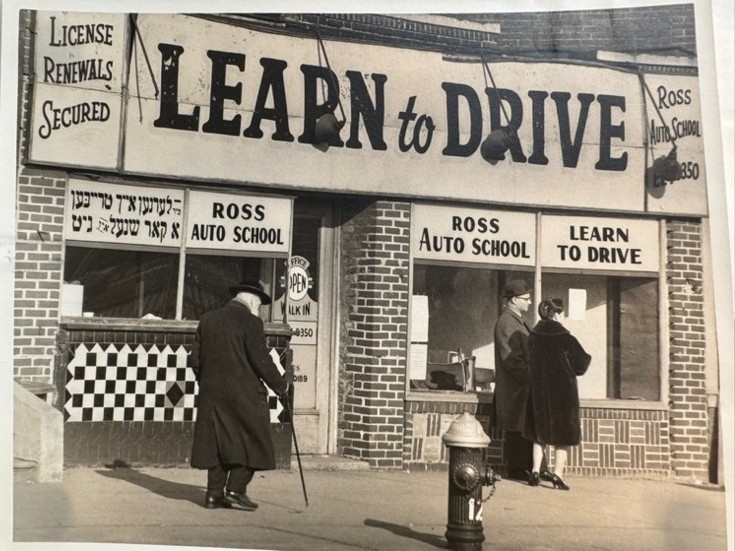 A driving school in Williamsburg circa 1960s.
Papers of Irving Hertzberg. RG 600. Collection of YIVO Archives.
Around the same time, another community was just establishing itself in Williamsburg, Brooklyn. For small groups of Holocaust survivors, most of whom were not Hasidic before the war, a neighborhood like Williamsburg brought the opportunity to start over in Ameirike. It also offered them something else: the ability to create a new community free from the assimilationist pressures of mainstream Jewish life in the suburbs. The brilliant book A Fortress in Brooklyn (2021) by Nathaniel Deutsch and Michael Casper dates the formation of Hasidic Williamsburg to the later half of the 20th century, just as other Jews were moving to the suburbs. While other Jews took the opportunity to assimilate into the middle class, Williamsburg’s Hasidic Jews saw the opportunity to create a “fortress” through a process of “Haredization.”
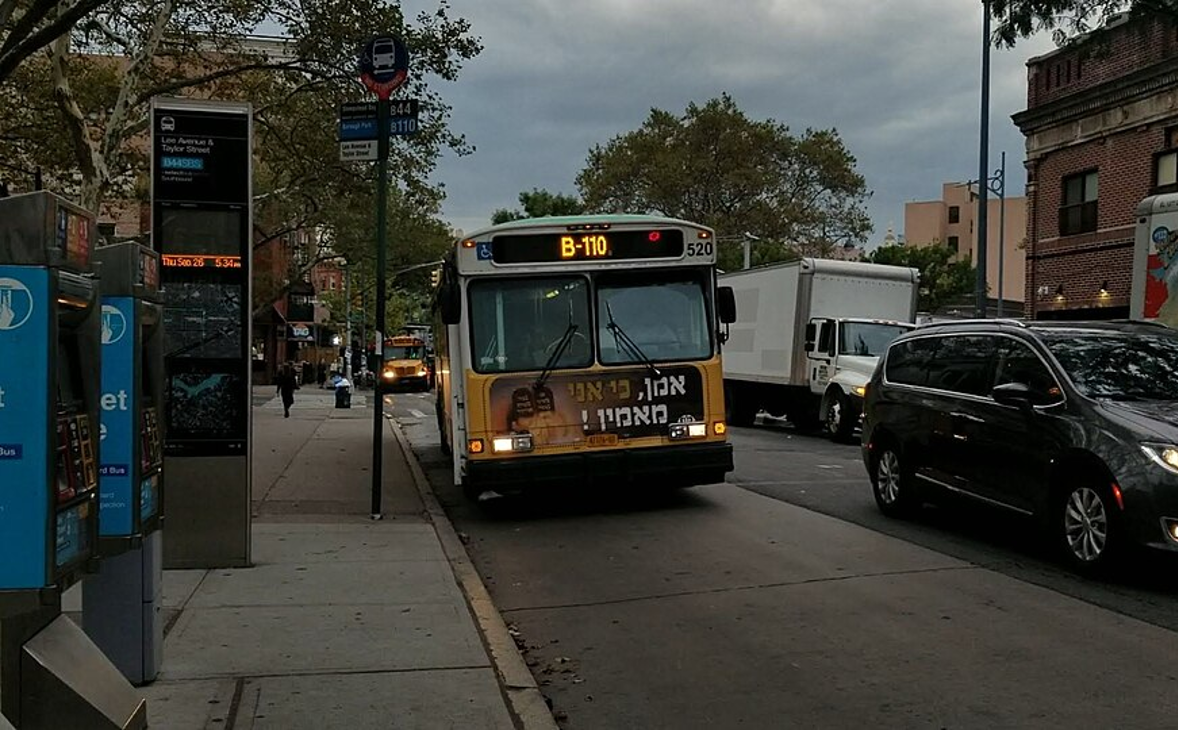
This Haredization happened over time in neighborhoods like Williamsburg and Boro Park. Hasidic communities saw explosive demographic growth coupled with the decline and outmigration of existing local Jewish populations. Strong Hasidic institutions absorbed a considerable segment of the local non-Orthodox Jewish population, while others progressively moved out as the area became increasingly dominated by Hasidic life. In conversations with several people who grew up in or live in South Williamsburg and Boro Park (the two neighborhoods are connected by the special, privately operated bus B110x today), they all told me the same story: the neighborhoods have become more and more Hasidic over time.
Over the last 80 years, the Hasidic community has largely come to dominate parts of Williamsburg. This pushed local Black and Hispanic populations further into Bed-Stuy, faced with the twin pressures of gentrification in North Williamsburg, and Haredization in South Williamsburg.
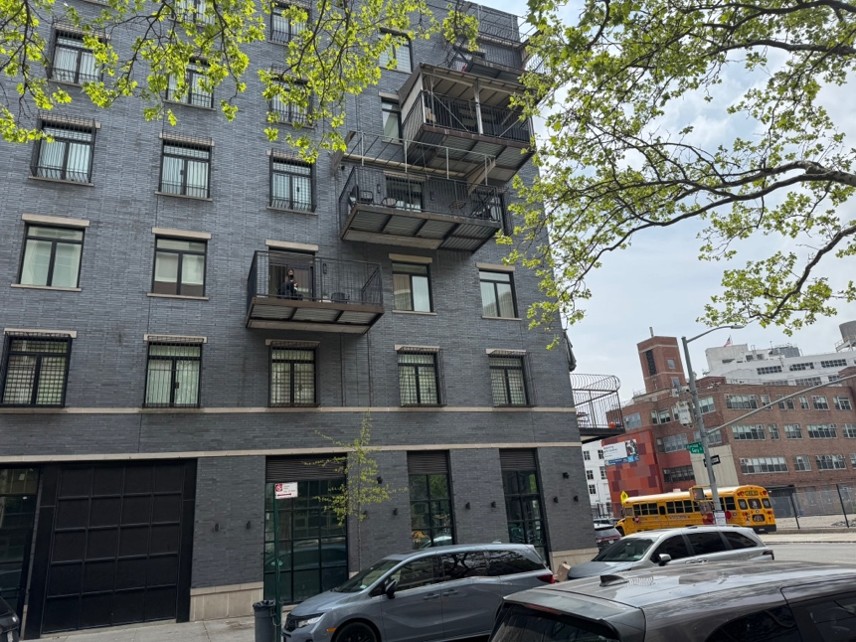 Apartment blocks in “New Williamsburg” with staggered Sukkah balconies. Photo provided by Author.
South Williamsburg’s official vehicle today is either the Honda Odyssey or the yellow school bus, something that sets the community apart from the surrounding areas. Indeed, on a walk down Lee Avenue it’s impossible not to notice that every block on the densely populated promenade of the neighborhood’s main artery is littered with yellow buses that seem to sit abandoned most of the day. In such a densely populated part of the city, it can be striking to think that car culture reigns supreme. When the city installed a protected bike lane on Bedford Avenue in 2024-2025, community officials quickly lobbied to have it removed, citing several instances in which children crossing the bike lane to reach their idling school bus were struck by cyclists. But it is also hard not to imagine that it wasn’t, at least in part, motivated by a desire to protect car culture and the feeling that bike lanes were an imposition from outside.
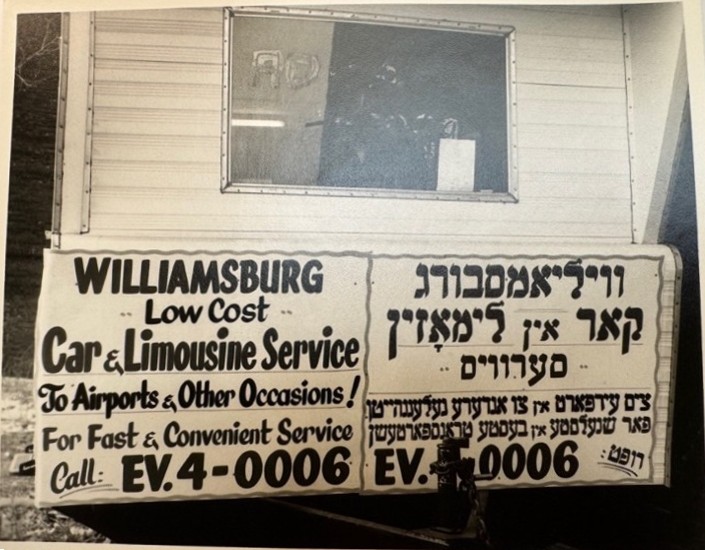
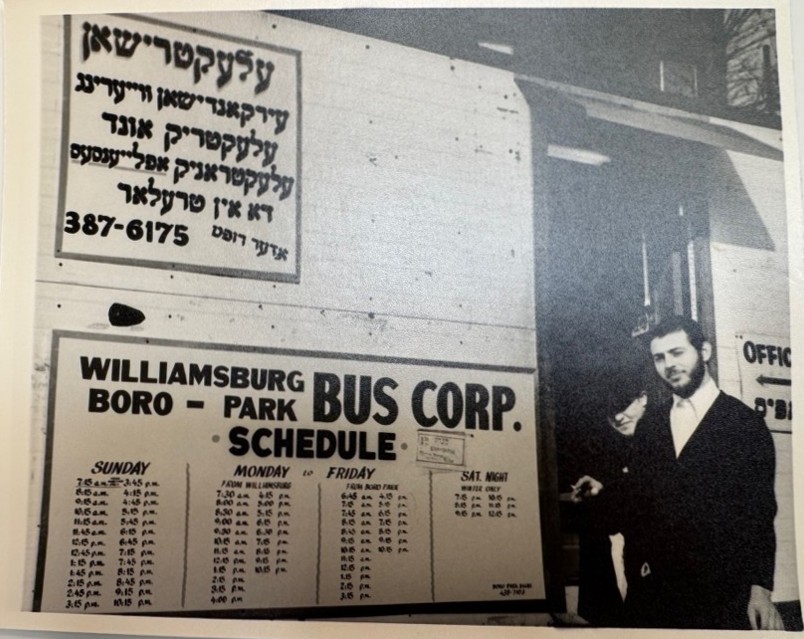 The schedule for the Williamsburg-Boro Park bus
Papers of Irving Hertzberg. RG 600. Collection of YIVO Archives
Today, South Williamsburg’s Hasidic community is expanding down into Bed-Stuy, sometimes informally called “New Williamsburg.” The suburbanization of Haredi communities notwithstanding, Williamsburg is now home to ±75,000 Hasidic Jews, and the community lacks options for local expansion. It’s likely one of the densest areas of the city, with new residential developments seemingly popping up in any and every available corner of space. With Haredi communities roughly doubling every 15-20 years, Williamsburg’s Hasidic community serves as both a reminder of Jewish life in the old country, and a sign of its future.
Related Materials at CJH
RG 600, Papers of Irving Hertzberg
A Fortress in Brooklyn: Race, Real Estate, and the Making of Hasidic Williamsburg / Nathaniel Deutsch and Michael Casper.


