
By Andrew Kotick, Leon Levy Fellow at the Center for Jewish History (2025-2026)
From the YIVO Stacks: Of Comic Strips and Antisemitism
A 1926 antisemitic pamphlet documents the antisemitic moral controversy surrounding the Jewish publishers that helped pioneer early French comic strips.
In the collections of YIVO Library at the Center for Jewish History rests an unassuming, yet unsettling French pamphlet from 1926 titled Juifs et Chrétiens inconciliables (“Jews and Christians: Irreconcilable”), written by lawyer and political polemicist Albert Letellier. The text is unusual and unstable: part courtroom transcript recollection, part antisemitic diatribe, and part documentary record of a public controversy that has largely faded from public memory. For historians of law, media, and antisemitism, however, it preserves a revealing episode in the formative period of comics and illustrated publishing in France.
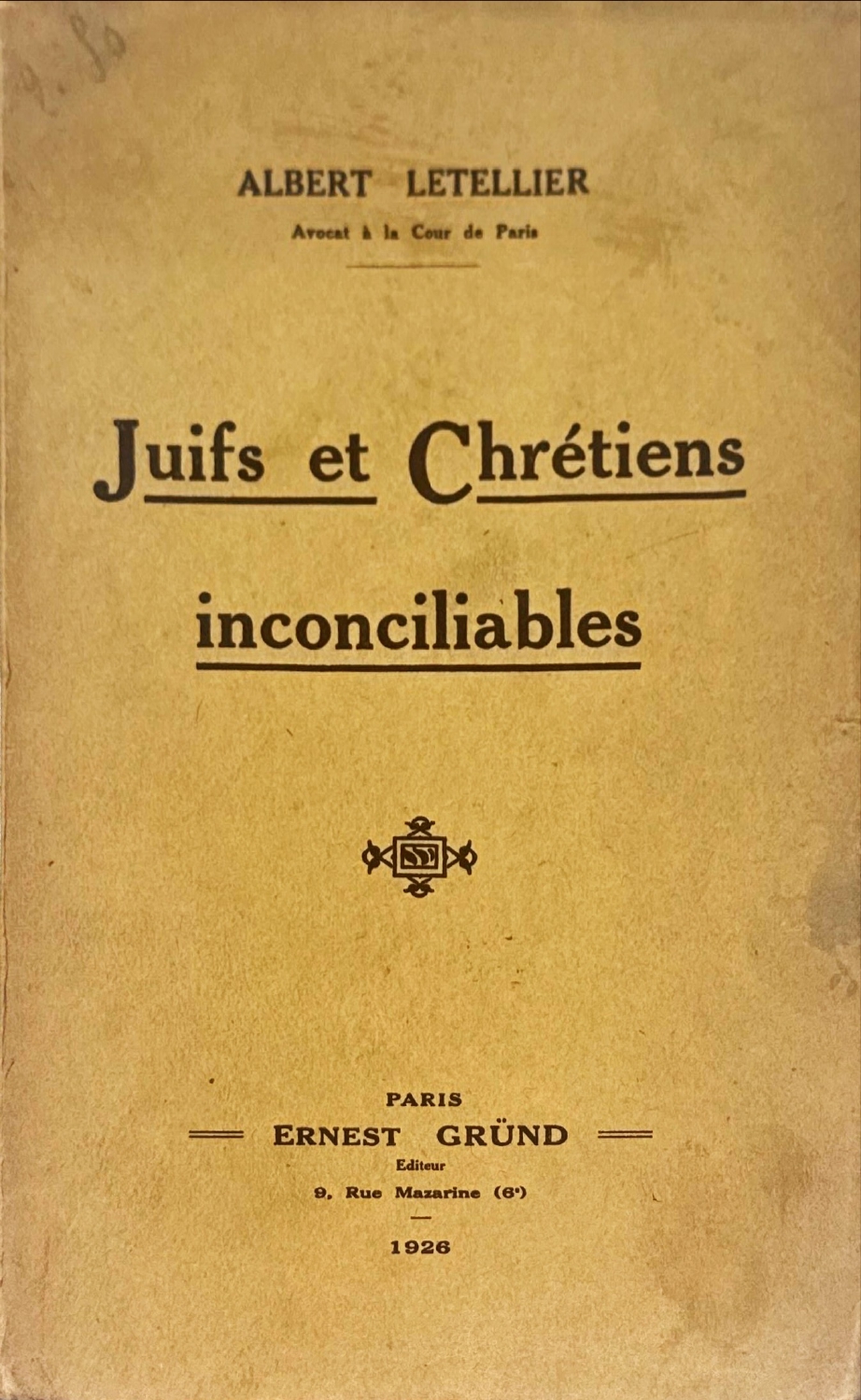
Albert Letellier. Juifs et Chrétiens inconciliables. Paris: E. Gründ, 1926, XIII. Collection of YIVO Library.
Much of the pamphlet recounts Letellier’s legal defense of the publishing house of the Offenstadt brothers, a Jewish family of Bavarian origin, who became major figures in the French popular press at the turn of the twentieth century. Through magazines such as L’Épatant, Fillette, L’Intrépide, and Le Petit Illustré, the Offenstadt Frères publishing house helped popularize illustrated children’s periodicals, and more specifically, serialized comic strips, or bande dessinée, for French readers. In 1908, L’Épatant began publishing Louis Forton’s Les Pieds Nickelés (“Nickel-Plated Feet, akin to “The Lazy Bums”), now considered one of the foundational works in the history of French comic strips.
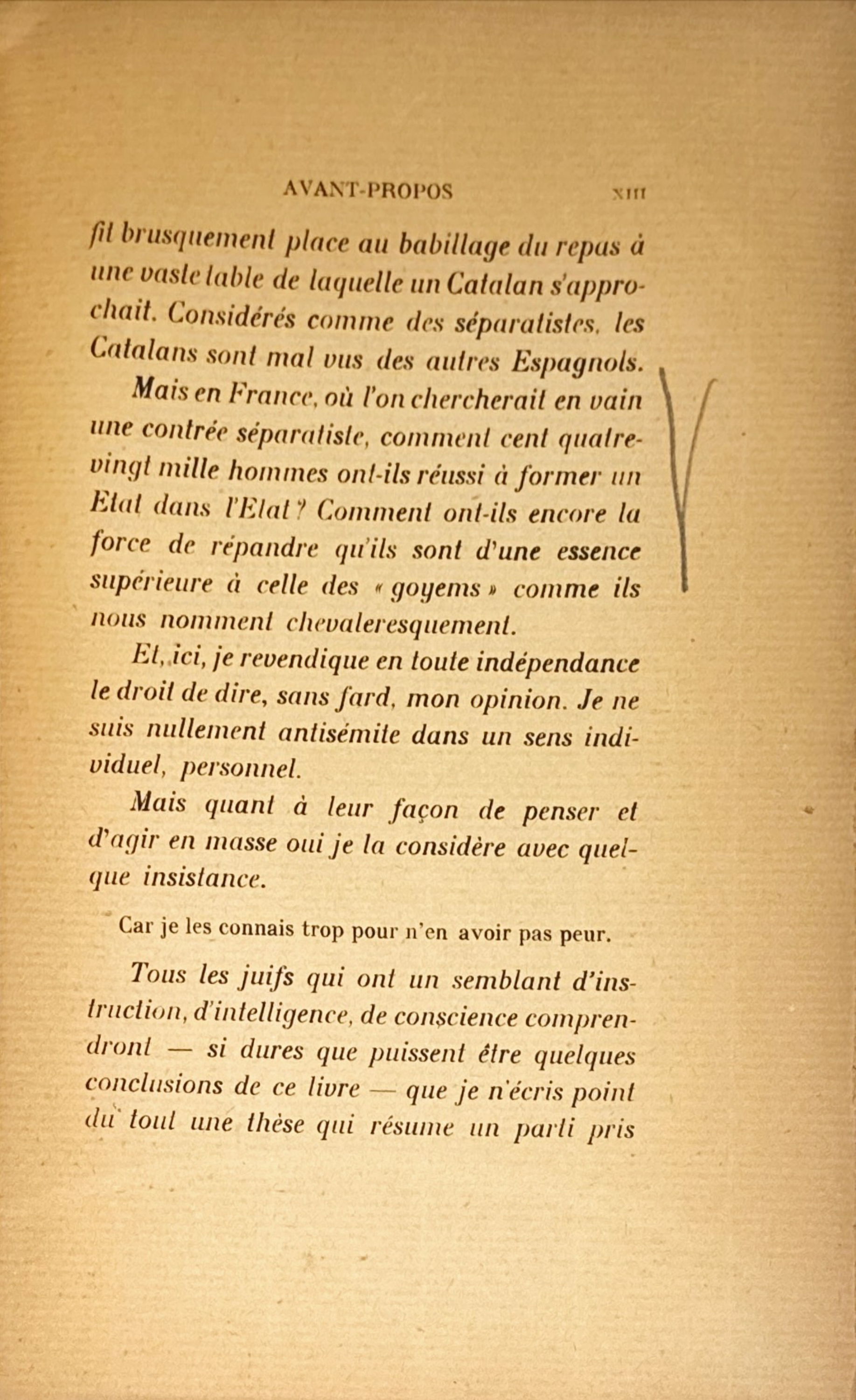
Quote from the text: “Et ici, je revendique en toute indépendance le droit de dire, sans fard, mon opinion. Je ne suis nullement antisémite dans un sens individuel, personnel. Mais quant à leur façon de penser et d’agir en masse, oui je la considère avec quelque insistance. Car je les connais trop pour n’en avoir pas peur.”
Here, I assert my right, with full independence, to say my opinion plainly. I am no antisemite in an individual or personal sense. But as for their way of thinking and acting as a group, yes, I consider myself one quite insistently. Because I know them too well not to be afraid of them.
Albert Letellier. Juifs et Chrétiens inconciliables. Paris: E. Gründ, 1926, XIII. Collection of YIVO Library.
Despite their popularity, Juifs et Chrétiens inconciliables is far from a celebration of publishing innovation. Letellier’s pamphlet reproduces legal proceedings stemming from libel suits and defamation charges that conservative critics brought against the family, whom they accused of obscenity and the moral corruption of French youth. A sustained legal and press campaign united republican moral reformers and the Catholic right, who continually denounced the Offenstadts as “Judeo-German pornographers.” In 1909, the Offenstadts were convicted of obscenity and fined for sexually explicit advertisements for titles in their catalogue unrelated to their comics periodicals. Moral reformer René Berenger used his influence as a senator to petition to have Offenstadt titles barred from sale in railway stations. Catholic polemicist Abbé Louis Bethléem embarked on a decades-long campaign to censor the same publications, routinely denouncing them as moral poison for French children. The family fought back, and routinely countersued their detractors for defamation, to the chagrin of local magistrates.
Letellier narrates events having served as the Offenstadts’ legal counsel. For his part, the author equivocates, trying to reconcile liberal republican universalism and defense of basic rights with his categorical, but supposedly “impersonal” hostility towards Jews as a group. He ultimately concludes that such a reconciliation is not possible. The pamphlet’s title is not ironic: even while defending the Offenstadt family from specific accusations, Letellier reproduced the same assumptions about Jewish separateness and supposed nefarious influence that animated the attacks against them in the first place.
The contradictions in Letellier’s thought are precisely what makes his pamphlet historically edifying. By the time of its publication, the Offenstadt family had become a lightning rod for much bigger anxieties about modern mass culture and society: the commercialization of leisure; the rapid proliferation of visual media; uncertainties about changing gender norms and expressions of sexuality; and collective worries about family relations and children’s welfare in an age of mass entertainment. The family’s public prominence as publishers and as Jews of “foreign” origin emboldened critics to fuse these uncertainties into a conspiratorial grand narrative about national decline at the hands of an enemy that was both alien and embedded within.
The controversy bears strange, striking parallels to later moral panic directed at comic books in the post-war United States, where moral critics portrayed comics as catalysts for juvenile delinquency, sexual deviance, and the decay of traditional authority. Both in France and the United States, public suspicions converged upon prominent Jewish publishers who helped shape industry standards. Decades before the Senate Subcommittee on Juvenile Delinquency targeted EC Comics’ Bill Gaines, the “Offenstadt Affair” inflamed antisemitic passions anew in France to intertwine fears of national decline with Jewish commercial influence and alleged civilizational incompatibilities.
Today, the Offenstadt family is primarily canonized as pioneers of bande dessinée and children’s publishing. Letellier’s pamphlet reminds us, however, that the early history of French bande dessinée was not solely a story of creative vision and commercial innovation. It was also deeply entangled in political struggles over immigration, religion, morality, and national belonging in modern France. The pamphlet captures a moment when comics and illustrated humor for children became contested sites of larger anxieties about collective identity and culture. It offers an unsettling reminder of how easily prejudice and exclusion can be folded into fears about mass media and social change. And one of the few surviving copies in the U.S. rests on the shelves at 15 West 16th Street.
Selected Sources
Groensteen, Thierry. La bande dessinée en France à la Belle époque. 1880-1914. Brussels: Les Impressions Nouvelles, 2022.
Le Collectionneur de bandes dessinées no. 35 (Novembre 1982): 13–30.
Letellier, Albert. Juifs et Chrétiens inconciliables. Paris: E. Gründ, 1926, XIII. Available through YIVO Main Stacks: 000023309.

