By Maytal Mark, Arcadia Graduate Student Fellowship (2025-2026)
Passports and Identities: An Egyptian Jewish American Story
In the fall of 1950, Victor Sanua arrived at Bowling Green State University in Ohio to study clinical psychology. He was a long way from his home and his family in Cairo, where he had been born in 1920. Not long after settling in for the semester, he wrote to them, “I have become a very popular guy at the university, being the only Egyptian, everyone wants to know about Egypt.” However, the reception for an Egyptian Jew in the American Midwest was not always pleasant: “Those ninnies are surprised of my proficiency in English.” He wrote in another letter, “They cannot believe that somebody coming from Egypt could speak English the way I do. They show complete ignorance of what goes on around the world.” 1
As he navigated life and study in a new country, Sanua leaned into Americans’ fascination with Egypt as an exotic and mythical place. He spoke to local schoolchildren, bringing in props like Oriental carpets: “In every school I go to I carry them [the rugs] with me, and everyone stands there, mouths agape at their beauty. They think they’re magic carpets. If they only knew that they only cost five dollars for the pair, they’d stay agape forever.”2
Like many middle-class Egyptian Jews of his generation, Sanua was fluent in his parents’ first language, French, as well as Ladino, which the family spoke at home. His letters home were studded with Arabic and Ladino asides, as well as some American slang picked up from fellow students: “Je suis vraiment content d’entendre de vos bonnes nouvelles inshallah dayman3 and listen you Ody [Sanua’s sister] don’t be silly in saying that you’re kind of a chatterbox in your letters, I really like them.”
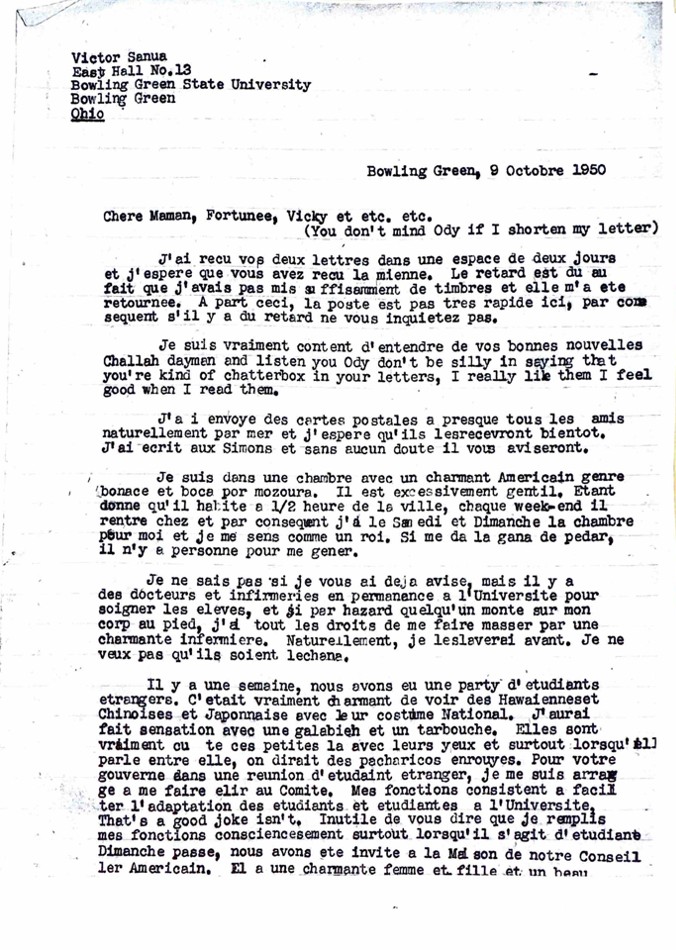
Sanua’s letter to his family used French, English, Ladino, and Arabic.
From the Papers of Victor D. Sanua, ASF AR-30. Courtesy of ASF’s National Sephardic Library & Archives at the Center for Jewish History.
However, Sanua’s family history and his multilingualism made his sense of himself as Egyptian complicated. Like many Jews of his generation, Sanua was not an Egyptian citizen. This became an acute problem when the 1947 Company Law imposed quotas on the number of Egyptian nationals employed in offices and factories. Sanua was dismissed from his job but then worked in the finance office of an American organization helping Palestinian refugees displaced in 1948 in Gaza. He became an UNRWA employee briefly when the UN took over the mission.
Sanua departed Egypt soon after, but the challenges with his national identity didn’t stop when he left. When Sanua sought help obtaining a scholarship from the Institute of International Education in New York, he had to explain his challenging situation: “Although I have an Italian passport, I was born in Egypt and five generations of Sanuas have been living in this country. Confidentially, it might take a decade or two or even more for someone to obtain the Egyptian nationality. You will no doubt realize that my permanent home is Egypt, my family is there, and I shall return to this country once I am through with my studies.” 4 When he was referred by the Institute to seek help from an Egyptian institution, he complained to a friend, “Obviously, I shall not bother to write to them since only Egyptians receive their help and the fact that I am a Jew makes it even worse.” He was also ineligible for scholarships from the Italian government as he was not a resident there.
In addition to the challenges Sanua faced obtaining funding from state institutions who could not easily classify him as a national subject, being a foreign student in postwar America was economically challenging in other ways. Sanua relied on UNESCO book coupons sent from his family to pay for school supplies and had to find creative ways to secure American dollars, which were difficult to obtain in Egypt, including buying some on the black market. Sanua wrote to his sister confidentially that fall, revealing that he was pressed for money, attempting to work while pursuing accelerated studies, and eating just one meal a day to make his dollars last.
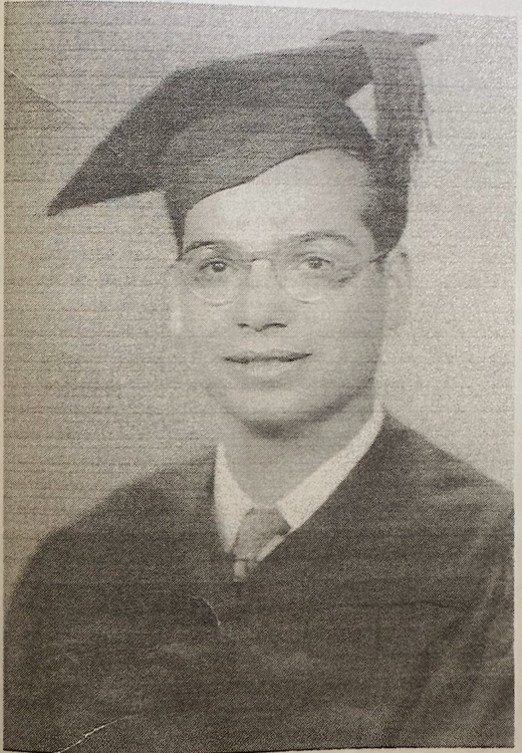
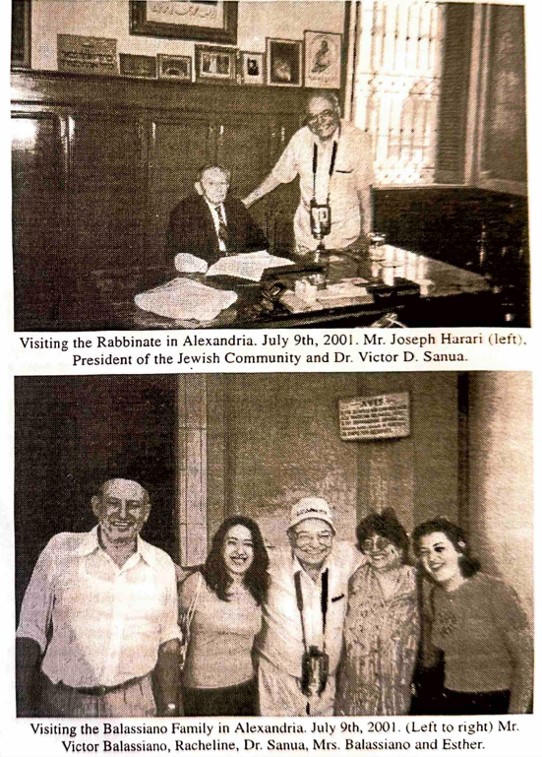
Victor Sanua in 1945 as a graduate of the American University of Cairo and Sanua in 2001 visiting Alexandria.
From Egyptian Jewry: Guide to Egyptian Jewry in the Mid-fifties of the 20th Century (2005). Courtesy of ASF’s National Sephardic Library & Archives at the Center for Jewish History.
Eventually, Sanua’s three sisters joined him in the U.S., and he enrolled in a Ph.D. program at Michigan State University that enabled him to extend his student visa. He later became an American citizen and an accomplished researcher and professor of psychology at institutions including Cornell University Medical College, Yeshiva University, and St. John’s University in Queens.
Later in life, Sanua also found a new way to relate to his Egyptian identity. He helped found the International Association of Jews from Egypt in 1997, publishing newsletters and collecting stories and photos from the Egyptian Jewish diaspora across the United States, France, Israel, Latin America, and England.
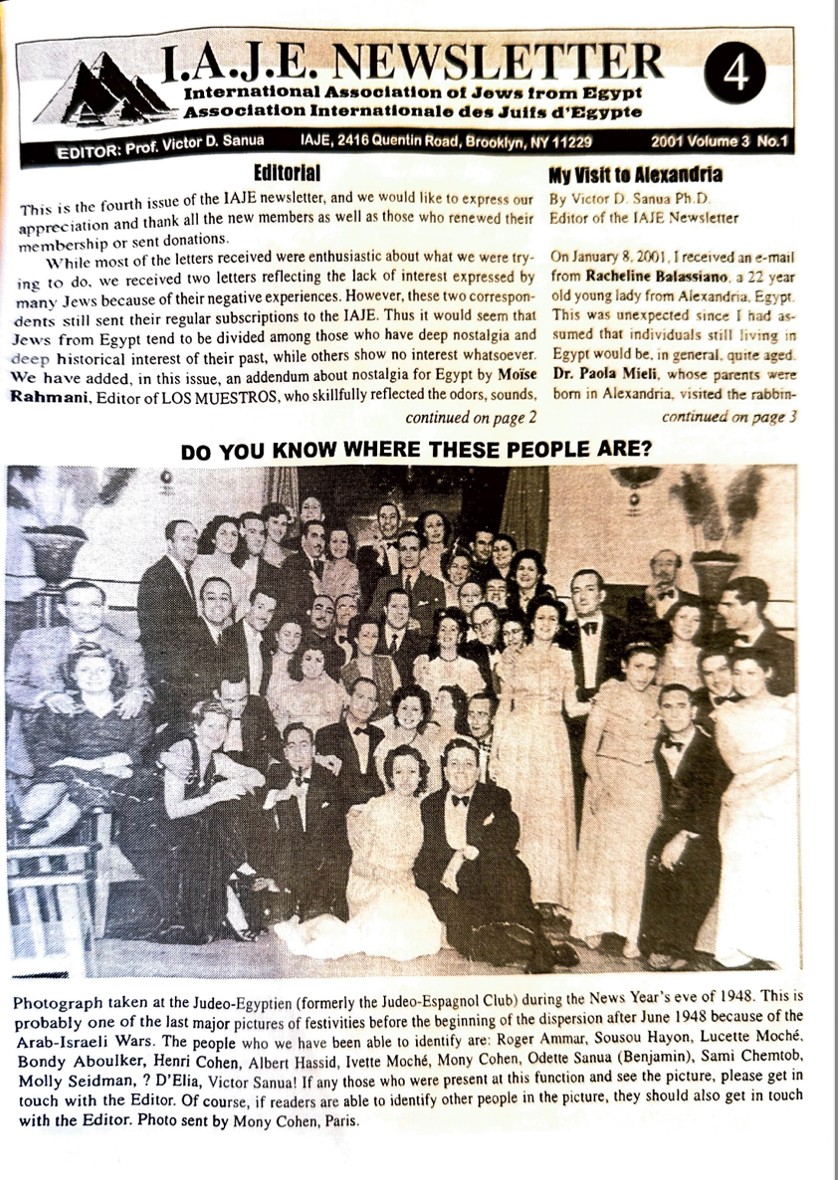
The front page of the IAJE Newsletter, edited by Victor Sanua.
Egyptian Jewry: Guide to Egyptian Jewry in the Mid-fifties of the 20th Century (2005). Courtesy of ASF’s National Sephardic Library & Archives at the Center for Jewish History.
Related Material
Rich materials from Sanua’s research into Egyptian Jews, the Sephardic diaspora, and his professional and personal papers are held by the American Sephardi Federation:
- Papers of Victor D. Sanua
- Egyptian Jewry: Guide to Egyptian Jewry in the Mid-fifties of the 20th Century : The Beginning of the Demise of a Vibrant Egyptian Jewish Community / Victor D. Sanua. Brooklyn, N.Y.: International Association of Jews from Egypt, 2005.
- October 28, 1950. Papers of Victor D. Sanua. ASF AR-30, Box 17, folder 2. American Sephardi Federation.
- November 18, 1950. Papers of Victor D. Sanua. ASF AR-30, Box 17, folder 1. American Sephardi Federation.
- Translation: I am very happy to hear your good news G-d willing, always.
- Letter to Eva, November 17, 1950. Papers of Victor D. Sanua. ASF AR-30, Box 17, folder 1. American Sephardi Federation.