
By Rachel Gordan, National Endowment for the Humanities Scholar in Residence 2025
A Major Breakthrough: When Passover Cakes Were Big News
At the end of the summer of 1955, Jewish novelist Herman Wouk’s (1915-2019) fourth novel, Marjorie Morningstar was published. At this point in his career, Wouk was a celebrity-writer, having won the Pulitzer Prize for fiction for his war novel, The Caine Mutiny (1951), which had just been made into a film starring Humphrey Bogart. Time magazine placed Wouk on their cover in the fall of 1955, and in its cover story, it described Wouk as a “devout Orthodox Jew who has achieved worldly success in worldly-wise Manhattan while adhering to dietary prohibitions and traditional rituals which many of his fellow Jews find embarrassing.” In many ways, Wouk’s religious observance matched that of his fictional heroine, Marjorie Morgenstern. Indeed, one of the striking aspects of the novel’s portrayal of Marjorie’s Jewish religious life is her struggle to keep kosher in “worldly-wise Manhattan,” without overly compromising on her social life, which included dates at the Plaza and brunch with friends on Tavern on the Green. It is unlikely that a bestselling novel had ever before so realistically portrayed this everyday challenge of eating as observant Jews.
While researching the 20th century history of Kashrut in America, for an academic journal article about the extensive portrayal of kashrut in Marjorie, I was intrigued to find material from a 1956 conference on kosher food at Hunter College and later developments in the kosher food industry within collections at the Center for Jewish History.
In promotional material for the 1956 Hunter College symposium, it was announced that the event is “Probably the first event of its kind to be represented under the auspices of a major American educational institution, a symposium on “Jewish Life a Reflected in Jewish Foods” was held at Hunter College on March 6, 1956, under the joint sponsorship of Hunter College and the B. Manischewitz Company of Jersey City, New Jersey and Cincinnati, Ohio. In press reports on the symposium, it was reported that speakers expressed the “the increasing availability of dependably kosher traditional foods in packages form” which relieves housewives of much of her burden. With fewer hours in the kitchen, “the Jewish housewife can now come to the family table relaxed and ready to join amiably with her family in enjoying the meal, instead of merely serving it.” Kosher food manufacturing was thus touted as changing the quality of family time. Kosher food as a product of scientific research and resulting in improved quality of life was thus established.
But the real breakthrough in kosher food came a generation later when National Kosher Foods, Inc. announced: “a Major Breakthrough has occurred in the formulation of packaged Passover cakes which gives them the taste and texture of cakes made with flour, an ingredient denied Jews during Passover.”
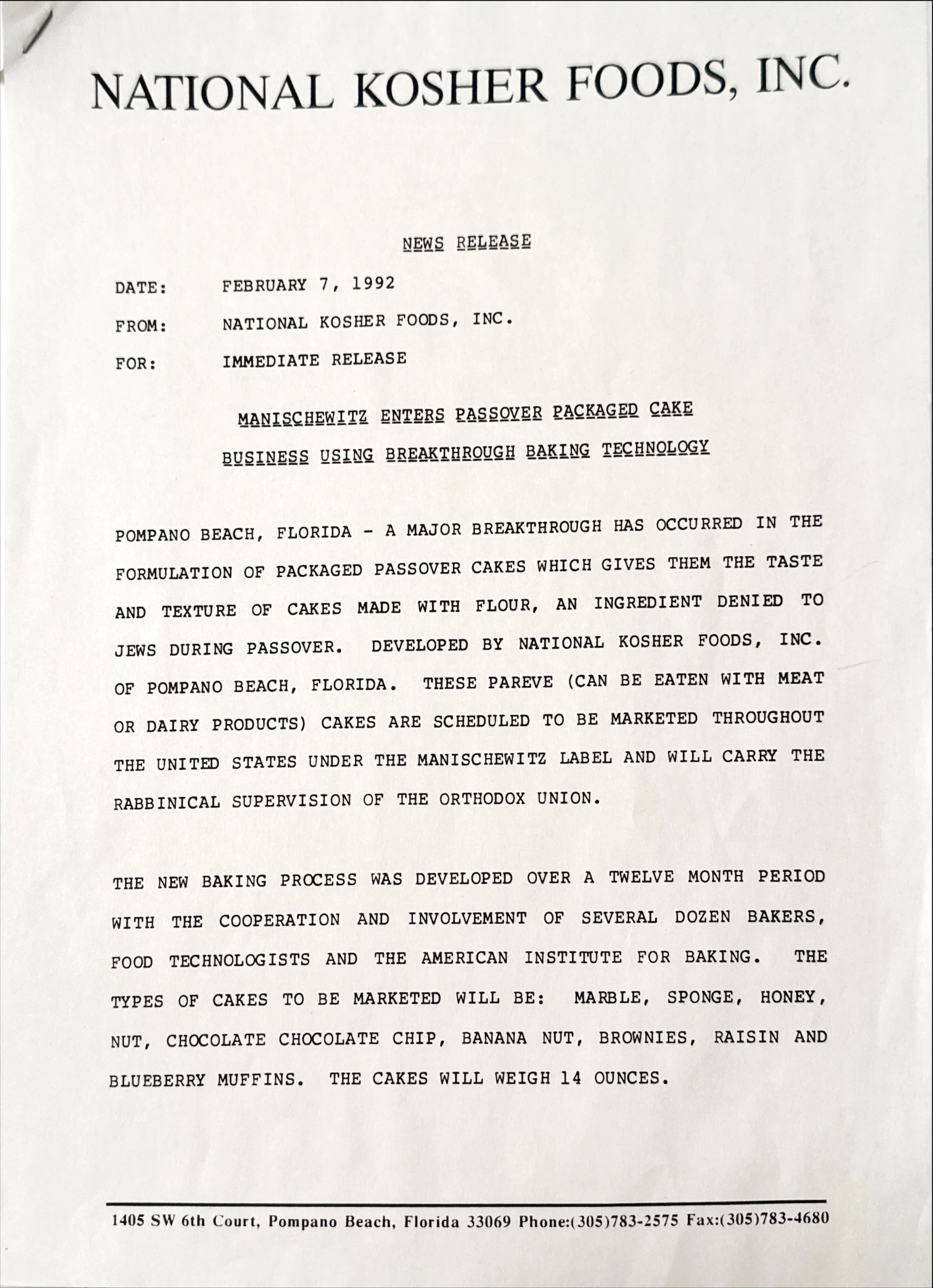
1992 Press Release from Manischewitz.
Image courtesy of the American Jewish Historical Society, New York. From the B. Manischewitz Company Records, I-286.
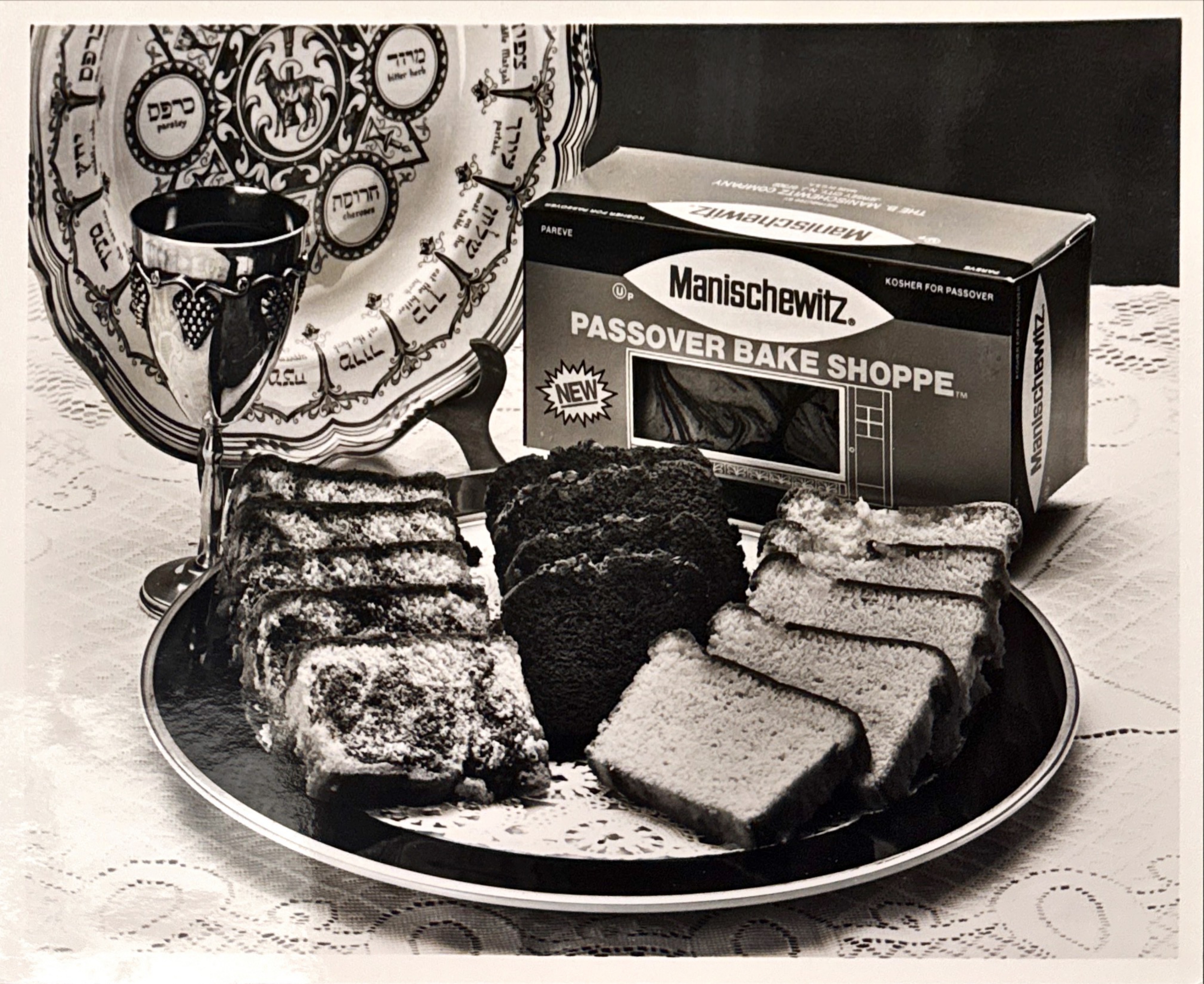
Images courtesy of the American Jewish Historical Society, New York. From the B. Manischewitz Company Records, I-286.
Where kashrut had once been regarded as part of Old World religious observance, seemingly at odds with modernity, kosher food manufacturing was transformed during the twentieth century, with regular reminders of the way technological developments made kosher living part of a modern American way of life.
